|
Prosticks Articles
Apple Daily --- July 16, 2000
Detecting Fake Trendline Breakout
In an earlier article we explained how to draw support and
resistance trendlines using Modal Points instead of the traditional
highs and lows. We also illustrated how Modal trendlines sometimes
provided an earlier trade entry point than traditional trendlines.
Today, we will take one step further and explain how Modal Points
can be used to prevent false trendline breakouts.
Figure 1 shows the Candlesticks chart of Pacific Cyberworks
(1186). L1 is a supporting trendline drawn from the low of A
and B based on the traditional approach. As can be seen,
price broke the trendline at C, suggesting a bear trend is
underway. However, after breaking the trendline, price immediately
reversed its course and instead, rallied sharply over the next few
days. The breaking of L1 at C was a technical trap.
Those who sold short after L1 was breached had suffered
tremendous loss.
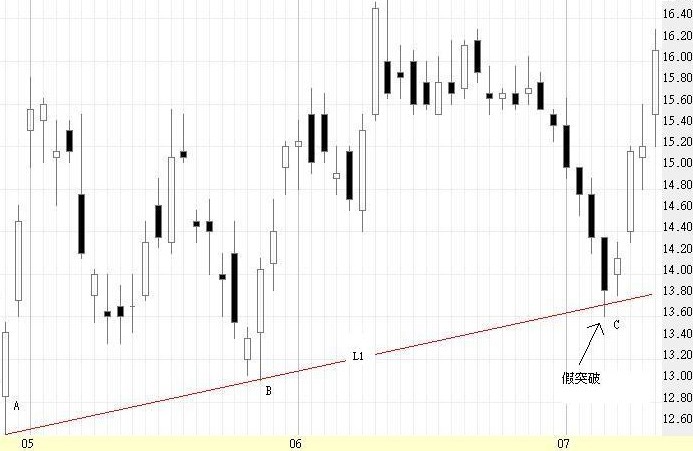
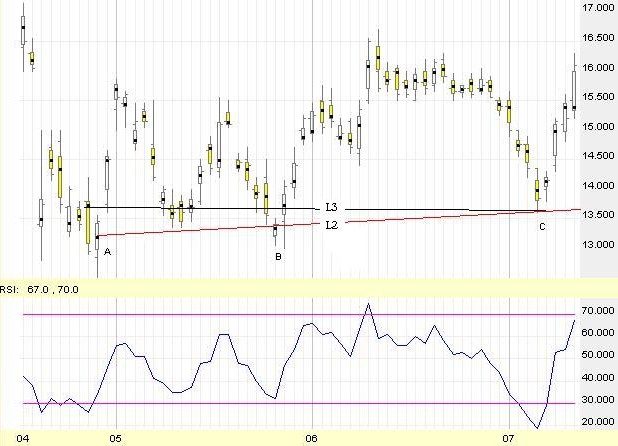
Figure 2 shows the corresponding Prosticks chart of Pacific
Cyberworks. L2 is the Modal supporting trendline drawn from
the Modal Point of A and B instead of the lows. As can
be seen, the low of C is exactly the same price as the Modal
trendline L2. Thus, while the traditional support line L1
is breached at C, thereby signalling a downtrend, the
corresponding Modal trendline L2 is still intact, signalling
otherwise.
Therefore, if an investor looked only at the Candlestick chart
and draws L1 as his trendline, he might have fallen into the
technical trap. However, had he consulted the Prosticks chart at the
same time, he would notice that the Modal trendline L2 is
slightly below L1. Thus, he should have waited until L2
is broken before going short, especially L1 and L2 are
close to each other. Subsequently, at C, when he observed
that price attempted to break L2 but failed, he should be
cautious.
Are there any ways we can forecast beforehand the market bottom
at C? Well, we should have due to the following reasons:
1. As explained before, at C, price temporarily touched L2
but closed back firmly above.
2. Coincidentally, the low at C lies on a previous Modal
Platform which consists of 4 Modal Points. A Modal Platform which
consists of more than 2 Modal Points can be regarded as a very
strong support. Thus, at C, we have two layers of support :
the Modal trendline and the Modal Platform.
3. RSI and Stochastics (not shown) are deeply oversold.
Thus, as explained in last week, a weak falling momentum meeting
a strong support, a rebound should have been expected.
Traditional trendlines are notorious for their false breakouts.
Since trendlines have been around for many decades and everybody
draws the same trendlines, traditional trendlines are subject to
manipulation by big money players. For example, big money players
may wait until a resistance line is broken before they start
distributing or until a support line is breached before they start
accumulating. Thus, investors should watch out for the bait of these
big money players.
|