|
Prosticks Articles
Apple Daily --- 30 July, 2000
Buy On Dip Strategy Using Modal Points
Buy on dip? Is one of the most widely used strategy in stock
trading. Specifically, after confirming an uptrend, one should wait
until a correction occurs and then buys when the correction is near
the end.
However, life is not that easy. To buy at the low of a
correction, one should (1) identify whether the current trend is
really a temporary correction instead of the beginning of a bear
trend, and (2) identify at which price the low of correction will
occur.
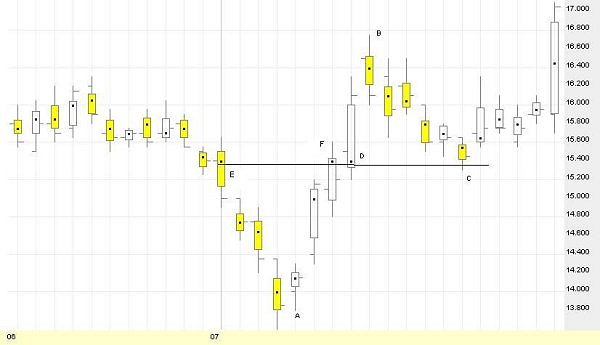
Figure 1 shows the Prosticks chart of Pacific Century Cyberworks
(1186). The powerful rally from A to B certainly
confirms a determining uptrend. As such, investors using the buy on
dip? Approach should wait for a correction to occur and buy on the
low of the resulting correction.

From B to C, the market undergoes a correction
phase after the powerful rally. How can we know that it is a
correction but not a bear trend? Well, notice that from B to C,
the market has fallen six days in a row. Even so, the market fails
to fall below even the low of bar D, the last rising bar
before the correction. This shows that the market tumble from B
to C lacks strength, compared to the prior powerful rally.
Thus, the tumble is a correction, not a bear trend. Notice also that
on average, the Active Ranges of bars from B to C are
shorter than those from A to B.
Okay, the next question is, how can we know that the correction
stops at C? As explained above, since all the six falling
bars from B to C are contained inside the single bar D,
naturally, D?/B>s Modal Point, which is situated at the bottom of
the bar, should provide support when price tests there. A correction
phase usually lasts about three to six bars. Thus, at C, after
falling six days in a row, and price is near the Modal Point of D,
the correction is likely to end there.
Notice that coincidentally, the Modal Point of D lies on the same
price level as the Modal Point of E and F, together forming a Modal
Platform, providing a strong support to prices. A Modal Platform
containing several points lying on the same price level means that a
lot of buying forces had accumulated at that price and thus when the
market falls to that level again, those buying forces resurface.
The low of an uptrend correction phase usually occurs at a
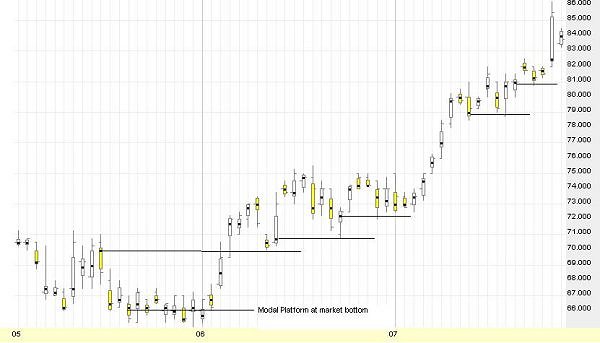
previous major Modal Point or Modal Platform. Figure 2 shows the
Prosticks chart of Hang Seng Bank. As can be seen, during the entire
uptrend, intermediary corrections always stop at some significant
historical Modal Points.

Of course, every bar has a Modal Point. Which Modal Points should
we use in forecasting correction lows? Modal Points filtering is an
art rather than exact science. One should rely on judgment,
observation of past patterns, as well as other traditional technical
tools to filter Modal Points which are significant from those which
may merely be random noise. Using those filtered Modal Points as
well as other technical tools such as RSI and Stochastics, one would
then have a better idea where the correction low would occur. We
have developed some effective techniques for Modal Points filtering.
Interested readers please visit our website to learn more about it.
|