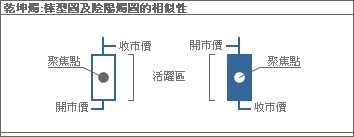
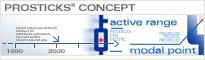
But what Market Profile lacks is a user-friendly graphical interpretation of the underlying financial instrument. Integrating the Market Profile distribution onto a Bar or Candlestick chart is very cumbersome and near impossible. The introduction of ProSticks attempts to reduce the limitations of Market Profile and other technical analysis and charting tools while, at the same time, integrates the elements of volume and time into traditional technical analysis and charting. In general, the ProSticks concept is similar to that of Market Profile's such that both focus on the bell-curve theory. Unlike traditional charting tools, ProSticks' innovative and intuitive charts provide the professional with crucial market information that can help one analyze with confidence the underlying structure and strength of the particular financial instrument. The ProSticks theory attempts to reduce the limitations that other technical analysis and charting tools encounter by including information to account for both time and volume. Thus, ProSticks has two variations: ProSticks-By-Time and ProSticks-By-Volume. These two concepts will be explained shortly.  ProStick's appearance is similar to both the Bar and Candlestick so technicians will not find the ProSticks bar foreign. The open, high, low, and closing prices are displayed exactly as that of a Bar chart and ProSticks' body looks very much like that of a Candlestick with a hollow stem signaling an up-day and vice-versa for a down-day.
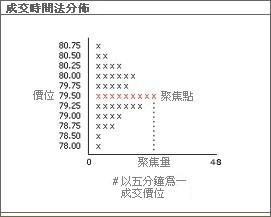
In addition to all of the information traditional technical charts provide, ProSticks' charts also include the following information: The Modal Point in a ProSticks bar represents the most heavily transacted price for the particular time interval. Similar to Market Profile, ProSticks uses the bell-curve theory to determine the Modal Point.  ProSticks-By-Time calculates the Modal Point similar to the way Market Profile builds its bell-curve distribution. The entire trading day is first divided into 5-minute intervals (i.e. 10:00 - 10:04, 10:05 - 10:09, 10:10 - 10:14, etc.). So for a trading day from 09:30 to 16:00, there are a total of 78 intervals (i.e. 6.5 trading hours x 12 intervals per hour). The total number of intervals each price had a transaction for will then be used to determine ProSticks' Modal Point. During one 5-minute interval for a particular price, whether there is one transaction or a thousand transactions, that interval is only counted once (i.e. x in the below distribution graph) towards calculating the Modal Point.
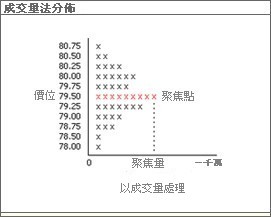
The Modal Point is then simply the price with the most number of transacted 5-minute intervals for all transacted prices in the trading interval (shown in red above). ProSticks-By-Time is most suitable when volume is absent, such as in the foreign exchange market. This form of ProSticks also helps weed out manipulation of financial markets caused by large inflows by a major player during a short period of time, such as during the open and the close when the price can be influenced very easily. False breaks are then less likely to occur with ProSticks than with traditional charting methods.  ProSticks-By-Volume calculates the Modal Point simply by taking the most heavily traded price for the trading day (or other trading intervals). The Modal Point is thus the price that had the most shares traded for that particular day.
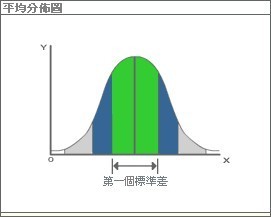
ProSticks-By-Volume is thus suitable for all financial markets that can quantify volume. Accompanying the Modal Point in the ProSticks concept is Modal Count and Modal Volume. The former is associated with ProSticks-By-Time while the latter is for ProSticks-By-Volume. Modal Count is the number of 5-minute intervals the Modal Point has transacted in ProSticks-By-Time while Modal Volume is the total volume associated with the Modal Point in ProSticks-By-Volume. As we will see later, the Modal Count and Modal Volume can serve as valuable technical indicators, nicely complimenting traditional technical tools.  Another striking feature of ProSticks is the Active Range. The Active Range is similar to the value area in Market Profile, such that it is derived from the normal distribution in statistical theory.
The Active Range for both ProSticks-By-Time and ProSticks-By-Volume is computed by first calculating the mean of the entire distribution. Then the first standard deviation away from the mean in either direction is added together to form the Active Range. The Active Range equals approximately 68 percent of the entire distribution (i.e. green shaded area in above graph). With ProSticks' Active Range, one will now be able to identify within a second exactly where most of the trading for any time interval took place and accurately spot false breaks and avoid being manipulated by the heavy hitters. |